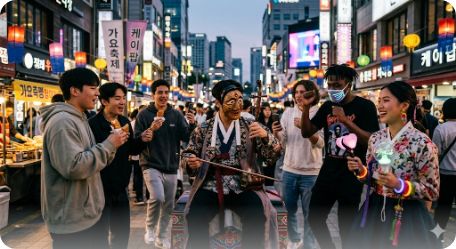
The “K-Factor” Formula: Why South Korea is Winning the Global Heart
If you’ve walked into a grocery store in London lately and seen a teenager debating the spice level of Buldak noodles, or noticed a high-end department store in New York dedicating an entire floor to “Glass Skin” serums, you’ve felt it. It’s the K-Factor.
In his recent CNN series, Daniel Dae Kim peels back the curtain on why South Korea’s export isn’t just products—it’s an entire lifestyle. But for the business world, the real story isn’t just about catchy choruses or spicy snacks; it’s about a “rising from the ashes” blueprint that any industry can learn from.
The “All-In” Mentality
What most people miss is that Korea’s global dominance wasn’t an accident. It was a survival strategy. Rising from the devastation of war and a massive financial crisis in the late 90s, the nation pivoted to “Soft Power” as its primary resource.
This birthed a hyper-competitive, fine-tuned formula. In K-pop, it’s the “trainee system”—a rigorous, multi-year process of refining talent until it’s world-class. In food, it’s the constant “Convenience Store Hack” culture, where brands innovate at lightning speed to satisfy a restless, trend-hungry public.
Scaling the Soul
How do you take something as hyper-local as Gochujang or a Korean-language thriller like Squid Game and make it a global necessity?
Emotional Resonance over Language: Whether it’s the heartbreak in a K-drama or the comfort of a warm bowl of Tteokbokki, Korean creators focus on universal human feelings.
Aesthetics as a Standard: In the “K-Formula,” “good enough” doesn’t exist. Packaging, cinematography, and presentation are treated with the same weight as the product itself.
The Feedback Loop: Korean industries are obsessed with digital engagement. They don’t just talk to the audience; they build ecosystems where the audience feels like part of the brand’s success.
The Takeaway
The “K-Factor” proves that rapid scaling doesn’t require losing your soul. It requires a relentless pursuit of quality and a mindset that treats every product as a cultural bridge. South Korea didn’t just join the global market; they redefined the vibe of it.
‘K-팩터’ 공식: 한류의 비상에서 비즈니스가 배워야 할 것
런던의 식료품점에서 불닭볶음면의 맵기를 진지하게 고민하는 10대를 보거나, 뉴욕의 고급 백화점 한 층 전체가 ‘유리알 피부(Glass Skin)’를 위한 세럼으로 채워진 것을 본 적이 있다면 당신은 이미 느끼고 있는 것입니다. 바로 ‘K-팩터(K-Factor)’의 힘이죠.
최근 CNN 시리즈에서 대니얼 대 킴은 한국의 수출품이 단순한 ‘제품’을 넘어 하나의 ‘라이프스타일’이 된 이유를 파헤쳤습니다. 하지만 비즈니스 세계에서 진짜 주목해야 할 점은 중독성 있는 후렴구나 매콤한 간식 그 자체가 아닙니다. 바로 그 기저에 깔린, ‘무(無)에서 유(有)를 창조한’ 비즈니스 설계도입니다.
‘올인(All-In)’의 정신
많은 이들이 간과하는 사실은 한국의 글로벌 장악이 결코 우연이 아니라는 점입니다. 그것은 일종의 생존 전략이었습니다. 전쟁의 폐허와 90년대 후반의 IMF 금융위기를 겪으며, 대한민국은 ‘소프트 파워’를 국가의 핵심 자원으로 선택했습니다.
이 과정에서 지독하리만큼 경쟁적이고 정교한 공식이 탄생했습니다. K-팝의 ‘연습생 시스템’은 인재를 세계적인 수준으로 다듬기 위한 다년간의 혹독한 과정을 거칩니다. 식품 업계는 어떤가요? 매일같이 쏟아지는 ‘편의점 꿀조합’ 문화 속에서 브랜드들은 트렌드에 민감한 대중을 만족시키기 위해 빛의 속도로 혁신합니다.
영혼을 확장하는 법
고추장처럼 지극히 한국적인 식재료나, 한국어로 제작된 ‘오징어 게임’ 같은 스릴러가 어떻게 전 세계인의 필수 아이템이 되었을까요?
언어를 넘어서는 감정의 공명: K-드라마 속의 가슴 아픈 이별이든, 따뜻한 떡볶이 한 그릇이 주는 위안이든, 한국의 크리에이터들은 보편적인 인간의 감정에 집중합니다.
표준이 된 심미성: ‘K-공식’에 ‘적당히’란 없습니다. 패키징, 촬영 기법, 그리고 프리젠테이션은 제품 그 자체만큼이나 중요한 비중으로 다뤄집니다.
실시간 피드백 루프: 한국의 산업은 디지털 소통에 집착할 만큼 진심입니다. 단순히 대중에게 메시지를 던지는 것이 아니라, 관객이 브랜드의 성공에 동참하고 있다고 느끼게 만드는 생태계를 구축합니다.
비즈니스의 교훈
‘K-팩터’는 급격한 규모의 확장이 반드시 브랜드의 정체성(Soul)을 잃어야 함을 의미하지 않는다는 것을 증명합니다. 오히려 품질에 대한 끊임없는 집착, 그리고 모든 제품을 하나의 ‘문화적 가교’로 여기는 마인드셋이 필요하다는 것을 보여주죠. 한국은 단순히 글로벌 시장에 합류한 것이 아닙니다. 그들은 시장의 ‘분위기’ 자체를 재정의했습니다.
답글 남기기